
Reliable Service From Start to Finish
A Data-Driven Look at the County’s Hidden Plumbing Risk
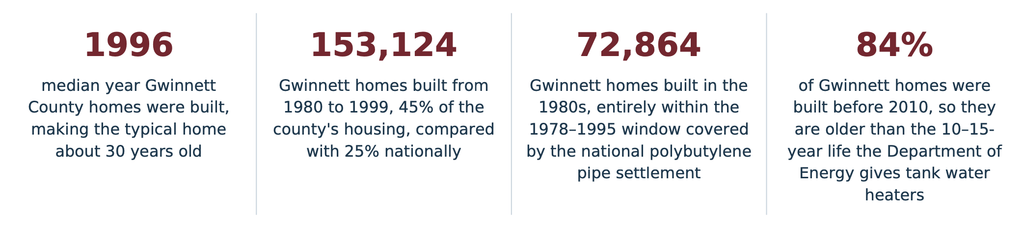
Gwinnett County’s housing stock looks young on paper. The median home was built in 1996 — sixteen years newer than the national average. But behind that number is a quieter story: 84% of Gwinnett’s 340,962 homes were built before 2010, making the overwhelming majority older than the full expected lifespan of a tank water heater. For most Gwinnett homeowners, this isn’t a future problem. It’s already here.
The Data Behind the Risk
Gwinnett County built its reputation as metro Atlanta’s growth engine on the back of two explosive decades. The 1980s and 1990s alone produced 153,124 housing units — nearly 45% of the county’s current supply, almost twice the national share of 25.3% for the same period. That’s not just a demographic footnote. It’s a plumbing timeline.
Those same decades — specifically 1978 to 1995 — are precisely when polybutylene pipe was widely installed across American homes. Gray, flexible, inexpensive, and ultimately prone to degradation and failure, polybutylene triggered a $950 million national class-action settlement that acknowledged the material’s documented failure rates. All 72,864 Gwinnett homes built in the 1980s fall entirely within that installation window. The settlement has closed. The pipes haven’t moved.
The risk doesn’t stop at polybutylene. The U.S. Department of Energy estimates tank water heaters last 10 to 15 years. With 84% of Gwinnett homes built before 2010, the math is unforgiving: a large share of the county’s housing stock is running on water heaters that have already exceeded — or are approaching — the end of their expected service life. Faucets carry a typical lifespan of 15 to 20 years. In homes built before 2000, original fixtures may be operating decades past that threshold.
The concentration is sharpest in specific communities. In Johns Creek, homes from the 1980s and 1990s represent 68% of all housing. In Peachtree Corners, that figure is 65%. These aren’t aging neighborhoods by appearance — but their plumbing infrastructure tells a different story.
Homes built since 2000 are in better shape. The 140,561 Gwinnett homes constructed after that threshold almost certainly carry PEX tubing, the durable cross-linked polyethylene material that dominates modern construction. But for the more than 200,000 homes built before it, the pipe running through the walls is a mix of copper, CPVC, and potentially polybutylene — none of it visible without opening a wall.
3 Takeaways for Residents
1. If Your Home Was Built Before 2000, Assume Something Needs Attention
With 59% of Gwinnett homes falling into this category, the odds are high that at least one major component — water heater, supply lines, or faucets — is past its expected service life. You may not see a symptom yet. That’s exactly the problem.
2. Polybutylene Doesn’t Announce Itself
If your home was built between 1978 and 1995, you may have polybutylene pipe and not know it. It was widely used, rarely flagged at resale, and visually identifiable only in exposed areas (gray plastic tubing, often marked “PB2110” near shut-off valves or under sinks). The national settlement that addressed it is closed — meaning no legal safety net remains.
3. Water Heater Age Is Your Highest-Probability Risk
A water heater past the 10-to-15-year DOE benchmark doesn’t come with a warning light. It simply fails — usually catastrophically, and always at an inconvenient time. In a home built in the 1990s with an original or once-replaced unit, that timeline has very likely already elapsed.
“Plumbing problems don’t announce themselves until something leaks. Knowing when a home was built, what pipe material runs through its walls, and how old its water heater is can be the difference between a planned replacement and an emergency.”
—Armand Leone, Owner, All Pro Residential, Gwinnett County, Georgia
The data backs this up. A burst polybutylene line or a failed water heater can cause thousands of dollars in water damage before it’s contained — damage that a single inspection call could have prevented. All Pro Residential works with homeowners across Gwinnett’s highest-risk communities, where the gap between housing age and homeowner awareness is widest and the need for proactive assessment is most acute.
About the Study
This analysis draws on U.S. Census Bureau American Community Survey (ACS) data for Gwinnett County housing unit counts, construction year distributions, and national benchmarks. Appliance lifespan figures reference U.S. Department of Energy published guidance on residential water heaters. Polybutylene installation timelines and settlement details are sourced from records related to the national Cox v. Microsoft / Shell Oil class-action settlement. Pipe material estimates are inferred from construction era data; no county-level physical inspection data exists. Geographic subsets for Johns Creek and Peachtree Corners were isolated from ACS community-level estimates.
5 FAQs
Q: How do I know if my Gwinnett home has polybutylene pipe? Check under sinks, near your water heater, or at your main shut-off valve for gray plastic tubing marked “PB2110.” If your home was built between 1978 and 1995, there’s a meaningful chance it was installed. A licensed plumber can confirm what you have during an inspection.
Q: My home was built in the 1990s. Should I replace my water heater even if it’s still working? Yes — proactively. The DOE’s 10-to-15-year benchmark is a lifespan estimate, not a guarantee. A water heater in a 1990s home has almost certainly exceeded that window. Waiting for failure means dealing with water damage on top of replacement costs.
Q: What’s the difference between polybutylene and PEX pipe? Both are flexible plastic tubing, but they’re not the same material. PEX (cross-linked polyethylene) is a modern, durable material that dominates new construction and carries a strong performance record. Polybutylene (PB) is an older material with documented failure rates — degradation caused by oxidants in municipal water supplies was central to the class-action settlement.
Q: I bought my home recently. Is plumbing age covered in a standard home inspection? Standard home inspections note visible plumbing conditions but typically don’t identify pipe material or assess age-related risk in walls. A dedicated plumbing inspection provides a more complete picture — especially in homes built before 2000.
Q: Why are Johns Creek and Peachtree Corners specifically higher risk? Because 68% of Johns Creek homes and 65% of Peachtree Corners homes were built during the 1980s and 1990s — the peak era for polybutylene installation and the period when most original water heaters and fixtures have already exceeded their expected service life. Concentration matters: in those communities, aging plumbing isn’t the exception, it’s the statistical norm.
Don’t Wait for the Leak.
Gwinnett’s pipes are aging faster than most homeowners realize. Whether you’re in Johns Creek, Peachtree Corners, or anywhere across the county, All Pro Residential can tell you exactly what’s running through your walls — before something goes wrong.