Reliable Service From Start to Finish
A dripping faucet. A running toilet. A buried irrigation line. Here’s the real price tag.
In Gwinnett County, every gallon you waste gets billed twice. The county’s $9.43-per-1,000-gallon sewer charge applies to all water your meter records — including water that soaks into your yard and never touches a drain. Add the $5.78 water rate and you’re paying $15.21 for every 1,000 gallons that leaks through a worn washer or faulty valve. A new study by All Pro Residential breaks down exactly what that means for your monthly bill — and why the numbers will keep climbing.
The Hidden Cost Built Into Every Gwinnett Water Bill
Most homeowners think of a leak as a nuisance. In Gwinnett County, it’s a line item — and a growing one.
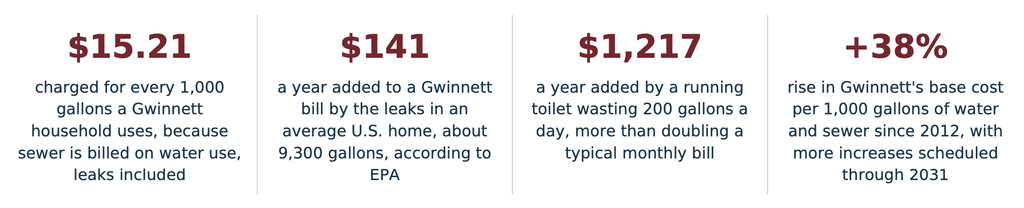
Gwinnett’s billing structure creates a compounding cost problem that most residents don’t realize until they see a spike in their statement. The county charges $5.78 per 1,000 gallons for water and an additional $9.43 per 1,000 gallons for sewer — applied automatically to all metered water, regardless of where it ends up. That means 62 cents of every dollar you spend on leaked water goes toward a sewer charge on water that never entered the sewer system.
The numbers are punishing at scale. A toilet with a faulty flapper wastes roughly 200 gallons per day without making a sound. That’s 6,000 extra gallons a month — enough to push a typical household out of Gwinnett’s base pricing tier and into higher per-gallon rates. The result: a monthly bill that climbs from $91.05 to $192.49, a 111% increase from one leaking fixture. Annualized, that’s $1,217 lost to a single toilet.
Outdoor leaks are equally costly — and far harder to detect. An irrigation line failure just 1/32 of an inch across wastes approximately 6,300 gallons every month. Because Gwinnett bills sewer charges on all metered water, irrigation water that disappears into the soil still carries the full combined rate. The annual cost: $1,264 — often for a leak hidden underground for an entire growing season.
The backdrop makes all of this more urgent. Gwinnett’s combined rate has risen 38% since 2012, from $11.00 to $15.21 per 1,000 gallons, with a scheduled increase to $16.78 by 2031. The EPA estimates the average U.S. home already leaks 9,300 gallons per year. At current Gwinnett rates, that’s $141 in avoidable charges annually for a typical household — a figure that will increase automatically as rates rise, whether the leak is fixed or not.
3 Takeaways for Gwinnett Residents
1. Your Sewer Bill Punishes Outdoor Leaks as Hard as Indoor Ones
Gwinnett’s automatic sewer billing applies to every gallon your meter records. An irrigation leak that soaks into the ground carries the same financial weight as water flowing through your kitchen sink. There’s no credit for water that never reaches the sewer — which means outdoor plumbing deserves as much attention as the pipes inside your walls.
2. Tiered Pricing Turns One Leak Into a Multiplied Bill
Gwinnett’s water rates escalate as usage climbs. A running toilet doesn’t just add a flat charge — it pushes your monthly consumption into higher pricing tiers, where every gallon costs more than the last. That’s why a 6,000-gallon-per-month leak can more than double a bill, rather than adding a proportional fraction.
3. Waiting Is the Most Expensive Option
The same leak that costs $141 this year will cost more by 2026 and more still by 2031 — automatically, by county rate schedule. Early detection and repair locks in today’s lower rates as the ceiling on what you owe. The longer a leak runs, the more each wasted gallon costs.
“Most homeowners are shocked when they see the numbers. They’re not just paying for the water they’re wasting — they’re paying sewer rates on it too. In Gwinnett, that’s the more expensive half of the bill.”
—Armand Leone, Owner, All Pro Residential, Gwinnett County, Georgia
Gwinnett’s sewer charge — $9.43 per 1,000 gallons — is 63% higher than its water rate of $5.78 per 1,000 gallons. That ratio means the less visible half of your utility bill is doing the most financial damage when a leak goes unrepaired. For homeowners who’ve dismissed a running toilet or dripping faucet as a minor inconvenience, the math tells a different story: sewer charges alone account for 62% of the total cost of every wasted gallon.
About the Study
This analysis was produced by All Pro Residential using publicly available rate schedules from Gwinnett County’s Department of Water Resources and leak volume benchmarks from the U.S. EPA’s WaterSense program. Leak scenarios — including a dripping faucet, a 200-gallon-per-day running toilet, and a 1/32-inch irrigation line failure — were modeled against Gwinnett’s current combined rate of $15.21 per 1,000 gallons and its tiered billing structure. Historical rate comparisons reference the 2012 base rate of $11.00 per 1,000 gallons. Forward-looking projections reflect county-published scheduled rate increases through 2031. Full methodology available on request.
5 FAQs
Q: Why does Gwinnett charge sewer fees on water that never enters the sewer? Gwinnett County, like many municipalities, bills sewer charges based on total water meter consumption rather than actual wastewater discharged. This means every gallon your meter records — including irrigation water, exterior hose use, and leaked water — carries the full sewer rate of $9.43 per 1,000 gallons. There is no automatic adjustment for outdoor or wasted water.
Q: How much does a running toilet actually add to a Gwinnett water bill? A toilet wasting 200 gallons per day adds roughly 6,000 gallons per month to your usage. For a household normally consuming 5,000 gallons per month, that volume triggers Gwinnett’s higher pricing tiers, pushing the monthly bill from $91.05 to $192.49 — an increase of $101.44, or 111%. Annually, that’s more than $1,217 from one fixture.
Q: How can I tell if I have a leak I can’t see? Turn off all water in your home, record your water meter reading, and check it again after 30 minutes without using any water. If the reading has moved, you have an active leak somewhere in your system. A licensed plumber can identify the source quickly, often within a single service visit.
Q: Are irrigation leaks really that expensive in Gwinnett? Yes. A leak just 1/32 of an inch wide — approximately the thickness of a dime — wastes an estimated 6,300 gallons per month. At Gwinnett’s combined rate of $15.21 per 1,000 gallons, that’s roughly $1,264 per year. Because irrigation leaks often occur underground or in unmonitored areas, they can run undetected for entire seasons.
Q: Will Gwinnett water rates keep rising? Based on county-published rate schedules, yes. The combined water and sewer rate has already increased 38% since 2012 — from $11.00 to $15.21 per 1,000 gallons — and a further scheduled increase will bring that figure to $16.78 per 1,000 gallons by 2031. That means the same leak costs more each time rates adjust, making early repair the financially conservative choice.
Stop Paying for Water You’re Not Using
Gwinnett’s billing structure is built to grow. Every undetected leak grows with it — adding charges every billing cycle, compounding with each rate increase, and costing more each year you wait.
All Pro Residential serves homeowners across Duluth, Lawrenceville, Norcross, Suwanee, and the broader Gwinnett County area with professional leak detection and plumbing repair built for the specific cost pressures local residents face.
Gwinnett’s pipes are aging faster than most homeowners realize. Whether you’re in Johns Creek, Peachtree Corners, or anywhere across the county, All Pro Residential can tell you exactly what’s running through your walls — before something goes wrong.